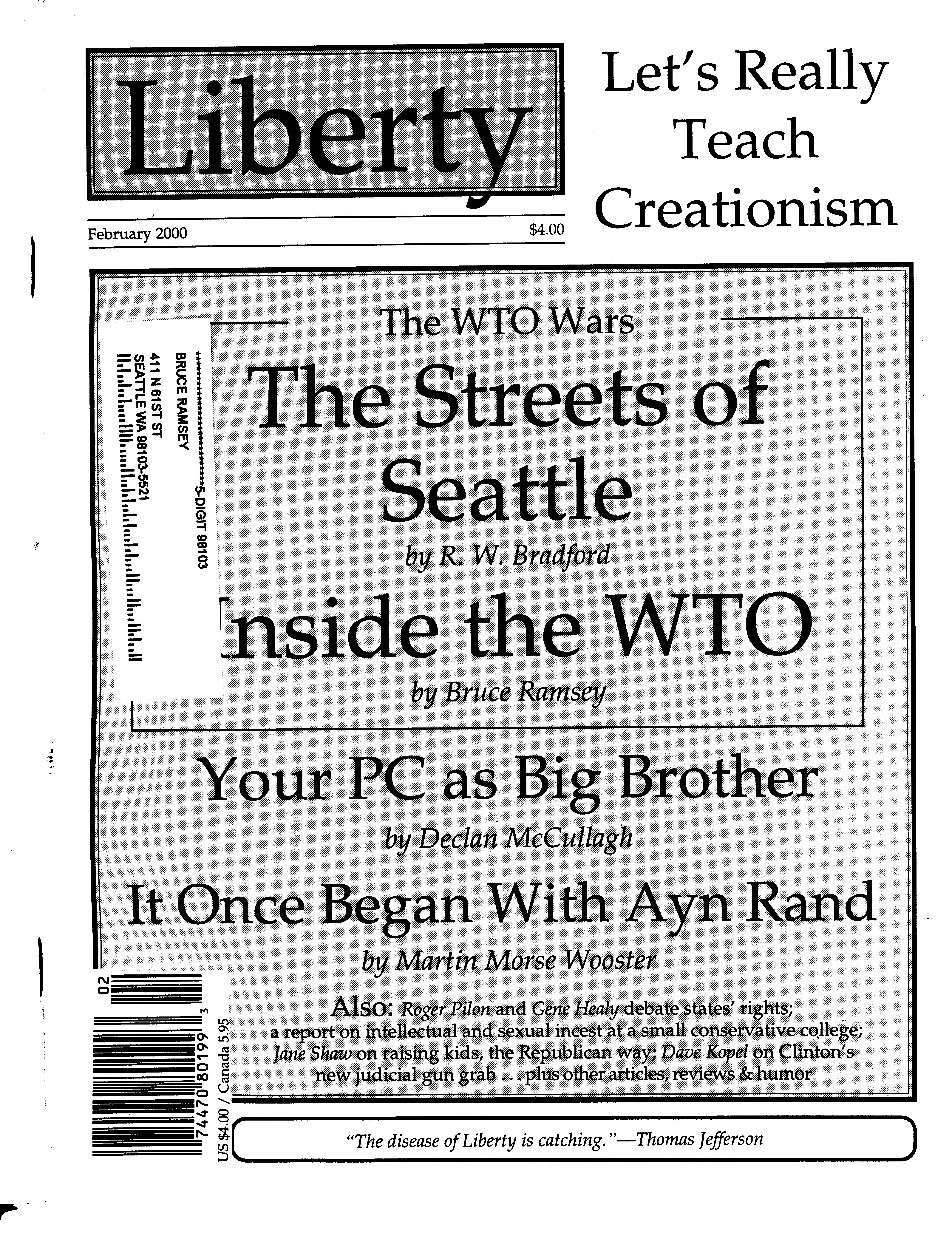
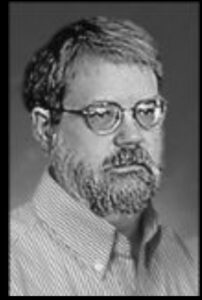
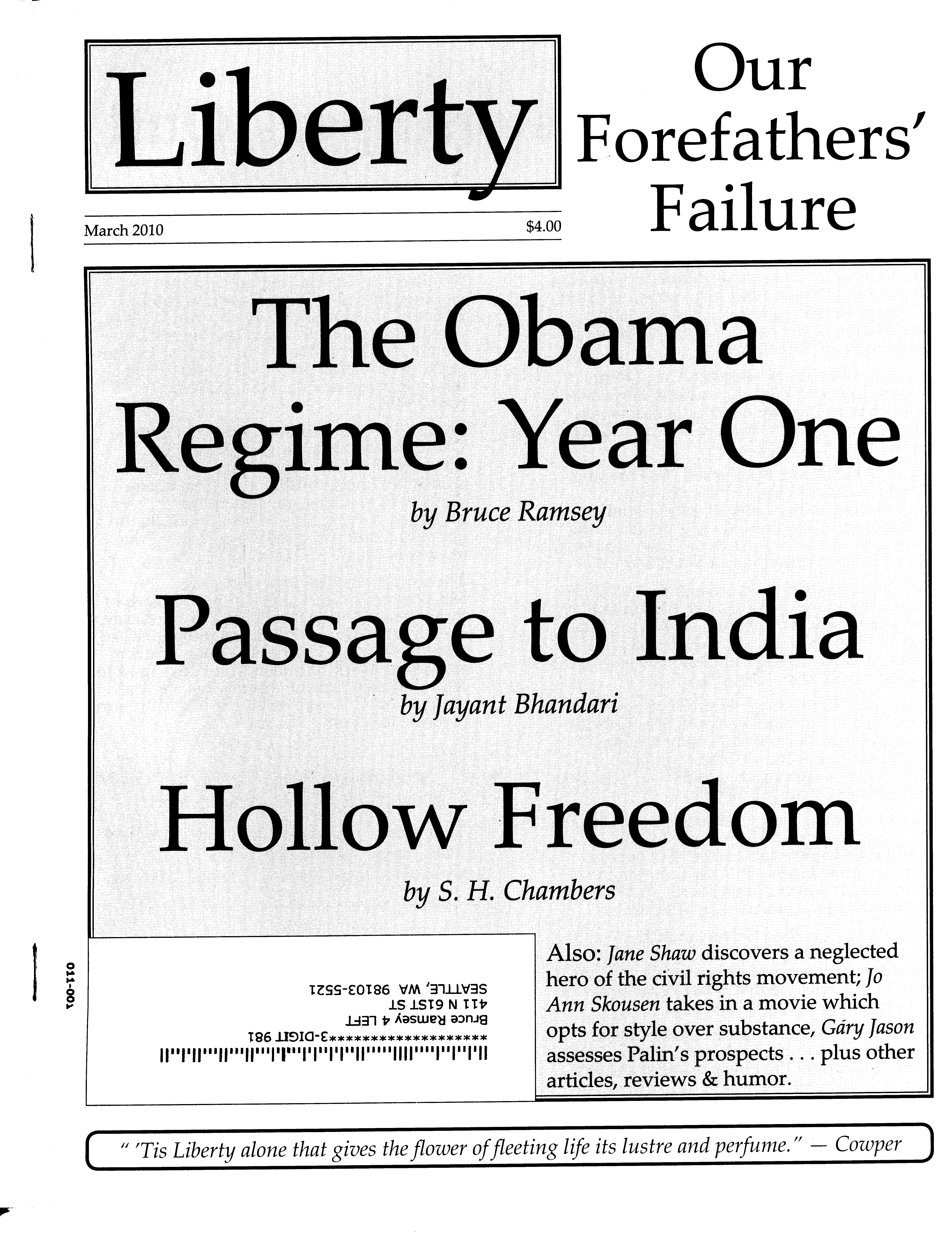
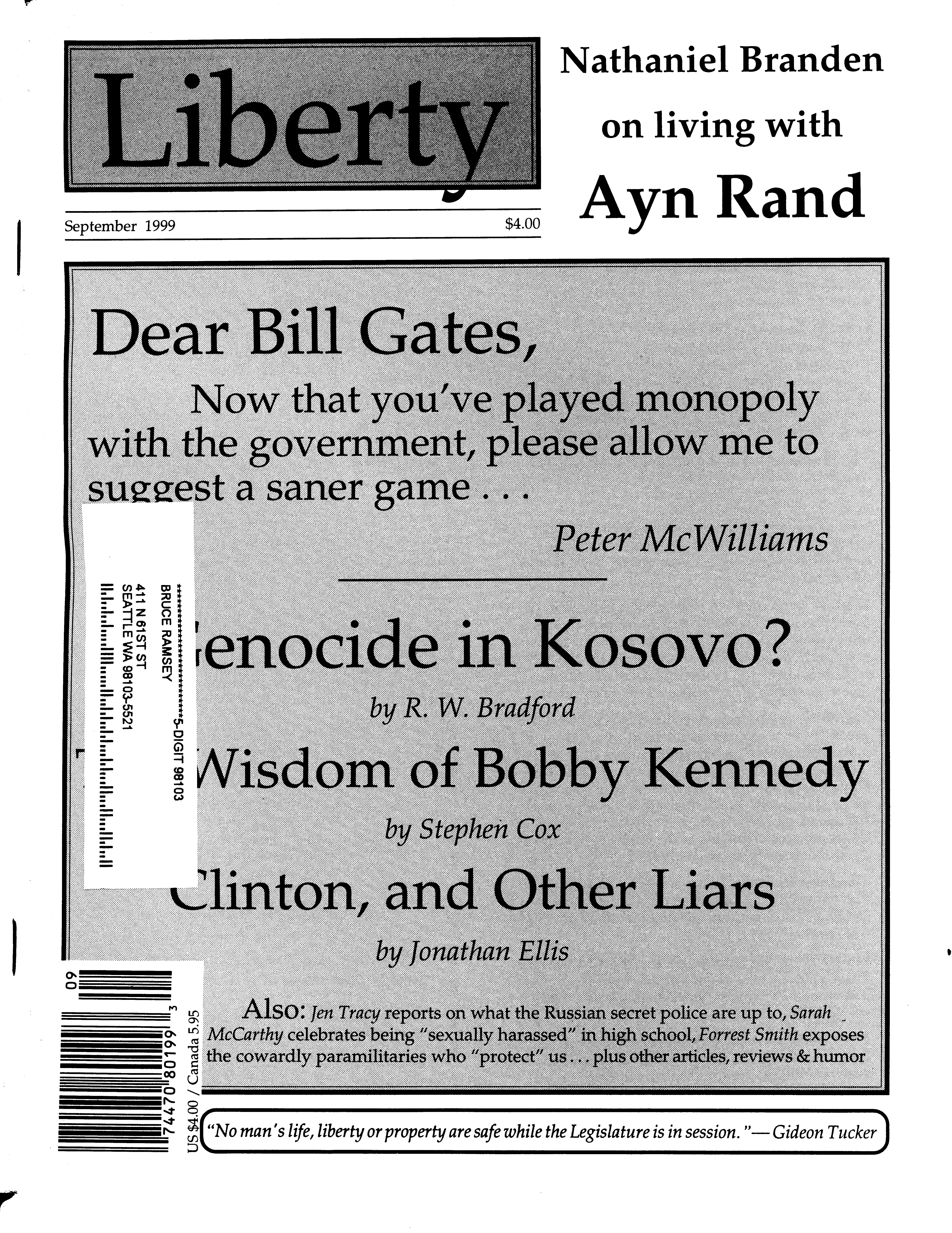
R.W. Bradford was the founder, owner and editor of Liberty, a libertarian and classical liberal magazine that existed from 1987 to 2010. I wrote this for the issue of December 2008, one year after he died.
I last saw Bill Bradford on December 7, 2005, the night before he died. I had not seen him since May, when he had come to Seattle for treatment of a cancer he thought was not terminal. By late July I could tell from his description over the telephone that it probably was. I didn’t say so and neither did he, though he talked about the future of the magazine if he didn’t make it. We talked several times more over the phone, but I didn’t think it was urgent to take the half-day needed to go to Port Townsend. Then suddenly, it was.
The Bill I visited on December 7 had aged 30 years in so many weeks. The cancer had got him. He was slumped in an easy chair, his neck no longer willing to hold up his head. He spoke only occasionally, as if he were at the bottom of a mineshaft. I sat next to him and talked. By and by I asked if he was following me.
“Yes,” he whispered. “Keep talking…. Fascinating.”
He had used that word on the phone a month before. Fascinating. Bill had lost the energy to do much more than listen, but the world still fascinated him. It could even annoy him. At one point, someone was talking about the sluggish service in the local restaurants, and Bill broke in with an ominous whisper, “Port Townsend… Get used to it.”
Pretty soon my conversational bucket emptied out, Bill’s sister Barbara took over, and Ross Overbeek and I went for some Thai food. We returned with boxes of Padang beef and chicken krapao, and all present tucked into the victuals except Bill. I began thinking of the man — not the ghost sitting across from me, but the Bill I remembered.
In February 2003, I had gone to see him. It is a two-hour trip from Seattle, crossing Puget Sound by ferry, and Hood Canal, which is not a canal, by pontoon bridge. I arrived at Port Townsend, the home of Bill and Kathy and Liberty.
Bill and Kathy had been born in the Midwest. They had moved to the Evergreen State in the ’80s, partly because it had no income tax. They had chosen Port Townsend, and antique town that was home to a pulp mill, a ferry to Whidbey Island and shops for the tourists. It is the sort of town that holds writers’ workshops and votes Democrat.
In the late 19th century, Port Townsend had been a customs stop for sailing ships. Promoters had envisioned a city, but they had put it on the wrong side of Puget Sound for rail connections to the East, and after the Panic of 1893, its exciting future had gone extinct. In the 1980s, Bill and Kathy bought a red brick office building that had been held by Jefferson County for 70 years for non-payment of taxes.
The building’s door was unmarked. Up a wooden stairway was a second unmarked door, behind which was Liberty. Bill was not community-minded and did not want to be bothered by boosters. He did not like the local government. He told me of a run-in with the town’s historical commission, which had authority over his historic building. Bill wanted to build a shed on the roof, and the commission did not want him to build a shed on the roof. Well, God rest his soul, Bill did not like public servants.
That night, I had stayed up with him until 1 a.m., talking about the bureaucrats, libertarian foundations, Republicans, fund-raising letters, some of the stars in the Liberty constellation — Victor Niederhoffer, Richard Kostelanetz, and so on. Besides running Liberty, Bill was in the coin and banknote business, and he was delighted when I said I had bid on eBay for national bank notes. Bill had a couple of shoeboxes of them.
On the second floor of Liberty’s offices was a bedroom where I snored while Bill edited copy on the floor below until 6 a.m. He worked at night, he said, because nobody called him on the telephone. He loved good talk — ideas, arguments, political gossip. He had to seclude himself in order to get his work done.
On Sunday morning I awoke alone. After going out for coffee, I poked around among the high shelves of unfashionable books. Bill had bought the library of Isabel Paterson and hundreds of other volumes. His practice regarding books was the opposite of mine, which is to have one set of bookshelves and to admit a new volume only after displacing an old one. He kept them all. He had everything from Ludwig von Mises and H.L. Mencken to Faustino Ballve — books I knew by reputation and books I had not seen in 20 years. I could have spent the whole morning peeking into his books, but the sunlight slanting through the high windows told me it was time to work.
The previous evening, I had edited the copy of a certain libertarian to the point of dismemberment. The writer was responding to another libertarian, and with more fulmination than common sense. The copy was rough, and several times I stopped and wondered if Bill had really meant it when he’d told me to do whatever it needed to make it readable. I decided he meant it, and mumbled my apologies to the writer’s ghost.
Bill tromped up the steps around noon and, thankfully, he was not interested in working. He wanted to show me his wilderness land, so we climbed into his truck and fled the antique stores and world savers of Port Townsend toward the logging country of the Olympic Mountains.
Bill turned onto a dirt road off U.S. 101, through a locked gate and past some hermits’ cabins posted No Trespassing. I’m a city guy, and I envisioned some survivalist popping up with a shotgun and demanding to know who the hell we were. Bill didn’t worry about it. From the crest of a hill, we looked down on a wild river that tumbled out of Olympic National Park and a rolling expanse of trees. “That’s my property over there,” he said. All green.
We had to get to it another way, lurching down a slope toward the river. On his property nowhere could we see the whole of it. A previous owner had built a cabin but all that was left was a derelict bathtub and a tangle of rusted steel. Around it were rain-loving maples and western red cedar, not too thick because the soil was rocky, but thick enough to filter the sun. Toward the river were patches of boulders, and you could see where the river had overrun its banks.
Bill’s property looked lush from a distance, but up close it was rough, its only natural bounty being the salmonberry, edible but not tasty. The place would be gloomy when it rained, which would be often. It was secluded, though; you might see an eagle there, or a bear. It was just the sort of place where you could step off your front porch and pop off a few rounds, which you could not do in Port Townsend.
Bill told me Kathy was not sold on the idea of moving to their forest property. I could imagine why, starting with living in the wooded gloom. And moving his books. Anyway, there was the magazine. In the woods, he would have freedom but be too far from Liberty. Living there was a romantic idea, and not practical.
I had once had breakfast with a former employee of Bill’s who said he was a fine writer and editor but not disciplined with his time. “Bill bites off more than he can chew,” the man had said. “It’s an old habit.” The magazine was often late, the web page was several years out of date and a promotional mailing was long overdue. Bill was always busy, but not always busy on the right things. He was a business owner — one could not imagine R.W. Bradford as an employee — but just as clearly, he needed to be managed. I imagined Kathy did a fair share of it, but I could see that Bill was not altogether manageable. Well, he was a libertarian.
He was 55 years old that weekend I spent with him. He told me he had diabetes and said his doctor had told him to lose 20 pounds. He said he’d been good about his diet, and said he knew a great place for a burger and curly fries. We went there. He was having a good time and I was, too, though I had offered to spend the day editing, and I wasn’t. Bill needed an excuse to get out of the office; he looked ragged, with more gray in his hair than at the last Liberty conference. He said he wondered how many years he would be able to keep going at the magazine, and that Kathy worried about his health. She was right about that, more than we knew.
Before he died, Bill told Kathy to scatter his ashes on their river property. She told me recently that she had not done it because the state wants the land for a park. Bill would not have wanted his ashes on government property.
I first dealt with Bill a third of a century ago, entirely over the phone, during the silver boom of the 1970s. He was in Michigan then, in the coin business. In my journal of January 16, 1974, I wrote, “I bought the bag of Canadian silver at the equivalent of $3.34 an ounce.”
Bill shipped me a bag of 10,000 dimes. It was not so big, but remarkably heavy. I dumped it all out on a Persian rug with a ka-WHOOSH, and started counting it. My hands turned gray with silver. After a while I compared my neat stacks of dimes with the uncounted heap, scooped it all into the bag and buried it under the house. Four months later, I dug it up and sold it back to Bill. In 1987, when I contacted him in Port Townsend about his new magazine, I told him I had been one of his coin customers. “Did you make money?” I told him I had made $850. “Good,” he said.
Bill launched Liberty at a time when I was not much interested in libertarianism, and he managed to rekindle an affection for it. I have always liked to write arguments; for most of the 1980s I had written a business column for the Seattle Post-Intelligencer. By the early 1990s I was working at Asiaweek, a Hong Kong magazine for which my writing was non-argumentative and my identity invisible. I chafed under that. I was forbidden to write freelance, so I wrote for Liberty under a pseudonym, R.K. Lamb, with the first article, about Hong Kong, appearing in March 1990. There followed another in 1992, and I have been in the magazine every year since. After 1993, when I came home, my articles were under my real name.
Sometimes my friends would say, “Why are you writing for Liberty? You could do better.” Well, I liked Liberty. And the biggest reason was that I liked Bill. I liked his mind. He was more radical in his beliefs than I was, but he was not a hedgehog about them. He once said, “You know, Liberty is a radical magazine,” and I thought, yes, I suppose it is, but there was always something provisional and experimental that made Bill’s radicalism down-to-earth. He tolerated my pragmatic streak. Once he even let me write an article defending fiat money, a stand he thought was terrible.
Bill was also a businessman. Most libertarians are pro-business but not worth a damn doing business. Bill had a mind for it. He was not interested enough to establish a big, efficient enterprise, but with Kathy’s help he did establish Liberty as a going concern, keep it alive for nearly 20 years and make arrangements to keep it going after he died. He didn’t float it on corporate donations, either. He was appalled at how much certain libertarian enterprises spent, and was proud that he had accomplished so much with so little.
I left Bill for the last time on December 7, 2005, telling him that he was a fine man and an important influence on my life. He nodded and waved his hand. I drove back to Seattle in the dark.
Bill was an admirer and defender of Mencken, a man who once said he judged people by whether they kept their commitments. Bill kept his commitments to me, and all the others I knew of. He paid his way in the world, including the medical expenses of his terminal cancer, which he bore without insurance. He created the libertarian movement’s principal inreach magazine, and kept it lively, a bit eccentric and out of the clutches of any faction. He did not demonize his opponents. He had a vision of a world different from this one, but he found this one fascinating to the end. I liked Bill, and I miss him.
.
.
Before he died, Bill offered me the editorship of Liberty. He said he had enough money to pay me the equivalent of my Seattle Times salary for the next five years. As a young man, I would have done it. But I wanted to keep earning a salary for more than five years; I was supporting a wife and teenage son, who would soon be of university age. I liked my post at the Seattle Times, which gave me an editorial-page column every two weeks to speak to 225,000 general-interest readers, not just libertarians. It was better to write occasionally for Liberty at zero pay.
The printed magazine died in 2010, five years after its founder did. It continued as a web page until the death of its editor, Steve Cox, in 2024.
©️ 2025 Bruce Ramsey